


Dive into the exciting world of AI agents and their communication infrastructure. By the end of this blog post series, you’ll be able to demystify AI agents, understand the roles of MCP servers and clients in LLM ecosystems, and learn how they enable seamless interaction between different AI components.
This blog post series covers the following topics.
1. Introduction to AI Agents. (Part 1 – You are here )
2. Large Language Models Overview (Part 1 – You are here)
3. Model Context Protocol Fundamentals (Part 2 )
4. MCP Servers and Clients ( Part 2 )
5. Integrating MCP with AI Agents ( Part 3 )
6. Advanced MCP Applications ( Part 3 )
1. Introduction to AI Agents
At its core, an AI agent is a system that can observe its environment, make decisions, and take actions to achieve a specific goal. Think of a simple thermostat. It perceives the room’s temperature (the environment), decides if it’s too hot or cold based on its setting (reasoning), and then turns the heat or air conditioning on or off (action). This is a basic form of an agent.
An agent is anything that can be viewed as perceiving its environment through sensors and acting upon that environment through actuators.
Modern AI agents are far more complex, but they all operate on this same fundamental cycle of perceiving, reasoning, and acting. They are the active components of AI, the part that does things, whether that’s booking a flight, managing a stock portfolio, or controlling a self-driving car.
The Agent’s Toolkit
Every AI agent, regardless of its complexity, is built from three essential components that enable its operation.

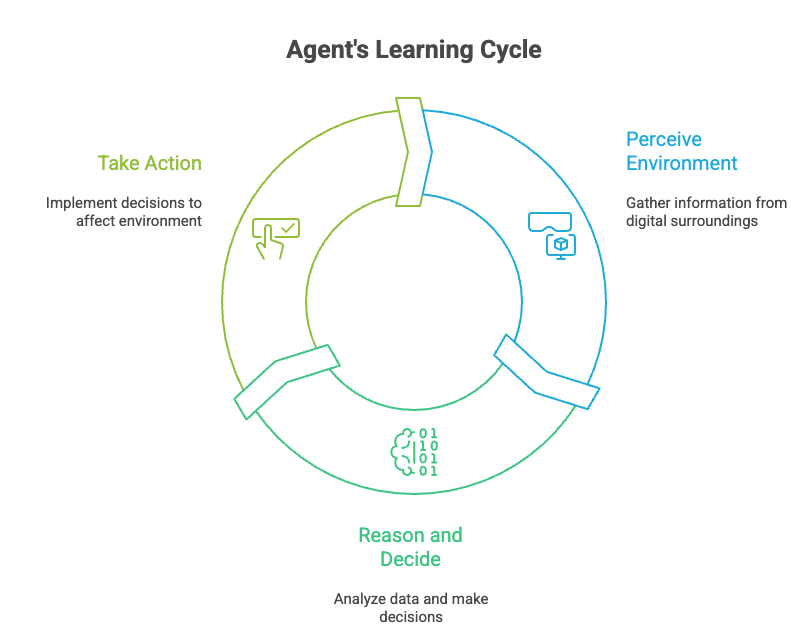
1. Perception This is how the agent gathers information about its surroundings. For a software agent, the “environment” isn’t a physical room but a digital one. Its “senses” might be APIs, user inputs, website data, or streams of text and numbers. Perception is the agent’s connection to the world it needs to understand.
2. Reasoning The reasoning component is the agent’s brain. After perceiving the state of its environment, the agent uses this engine to make a decision. This can range from a simple if-then rule (like the thermostat’s) to complex logical deduction or learning-based predictions. The goal of this stage is to choose the best possible action to achieve the agent’s objectives.
3. Action Once a decision is made, the agent must act. An action is any way the agent can affect its environment. This could mean sending an email, buying a stock, moving a robotic arm, or displaying a message on a screen. The action changes the state of the environment, which the agent will then perceive in the next cycle, starting the loop all over again.
Types of AI Agents
Agents aren’t all the same. They can be categorized based on how sophisticated their reasoning abilities are.

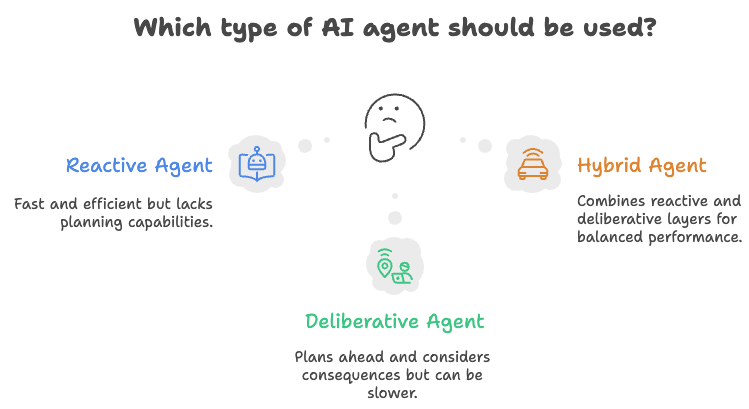
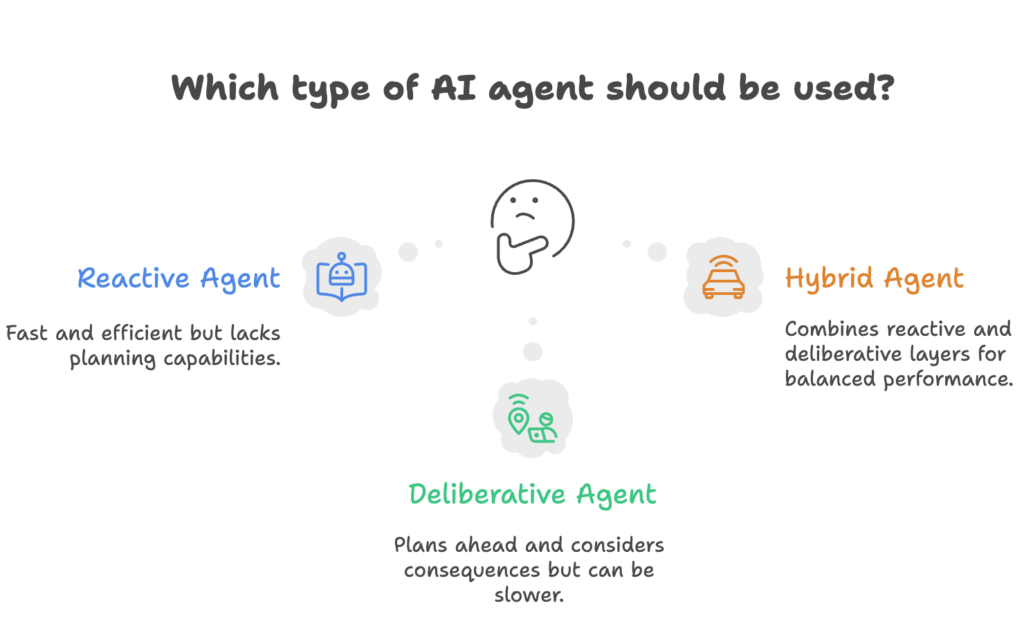
1. A Reactive Agent follows a simple rulebook. It reacts to its current perception of the world without any memory of the past. It’s like a computer opponent in a classic video game that always makes the same move in a given situation. They are fast and efficient but can’t plan ahead.
2. A Deliberative Agent is a planner. It maintains an internal model of the world and considers the consequences of its actions before taking them. It can think ahead, creating a sequence of steps to achieve a goal. A GPS navigation system that calculates the best route by considering traffic, distance, and road closures is a great example.
3. A Hybrid Agent combines the best of both worlds. It uses a reactive layer for quick, instinctual responses to immediate situations (like a self-driving car braking suddenly) and a deliberative layer for long-term, goal-oriented planning (like navigating from one city to another). Most advanced agents today are hybrid systems.
Agents in the Wild
AI agents are already integrated into many aspects of our daily lives and industries.

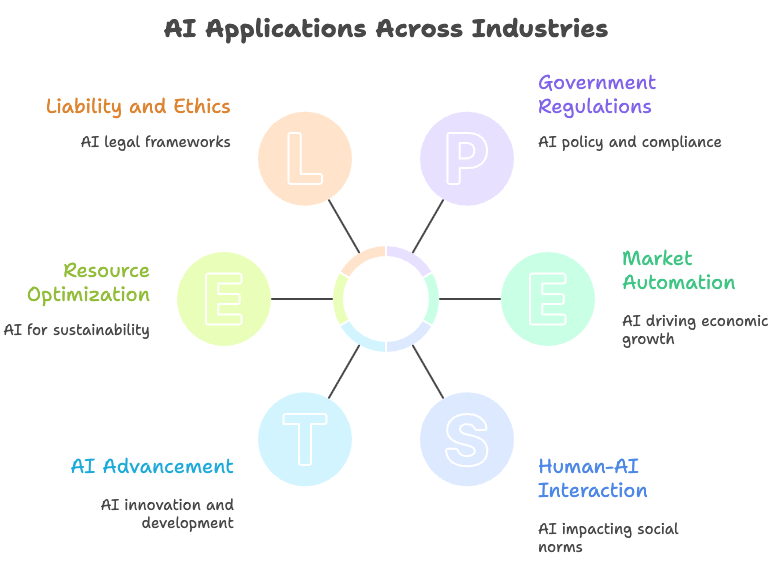
| Domain | Application |
|---|---|
| E-commerce | Chatbots that act as customer service agents, answering queries and guiding users. |
| Finance | Automated trading agents that perceive market data and execute trades based on complex algorithms. |
| Healthcare | Diagnostic agents that perceive patient symptoms and medical history to suggest potential diagnoses. |
| Supply Chain | Agents that monitor inventory levels, predict demand, and automatically place orders. |
| Smart Homes | Assistants that perceive voice commands and act by controlling lights, music, and other devices. |
These systems are powerful because they can operate autonomously, handling complex tasks tirelessly and often more efficiently than a human could. As AI technology evolves, these agents are becoming more capable, moving from simple rule-followers to sophisticated, goal-driven partners.
2. Large Language Models Overview
The Brains of Modern AI
In the last section, we talked about AI agents and their core components: perception, reasoning, and action. Now, let’s look at one of the most powerful engines driving the “reasoning” part of modern agents: Large Language Models, or LLMs.
A large language model (LLM) is an AI model trained on massive amounts of text data that can understand and generate human-like text, recognize patterns in language, and perform a wide variety of language tasks without task-specific training.
Hugging Face
Think of an LLM as a highly sophisticated pattern-matching system. It’s a type of neural network, which is a computing system inspired by the interconnected neurons in a human brain. The specific architecture most LLMs use is called a Transformer. The Transformer’s key innovation is a mechanism called “attention,” which allows the model to weigh the importance of different words when processing a sentence. It helps the model understand that in the sentence “The dog chased the cat, but it was tired,” the word “it” refers to the dog, not the cat, based on the context.

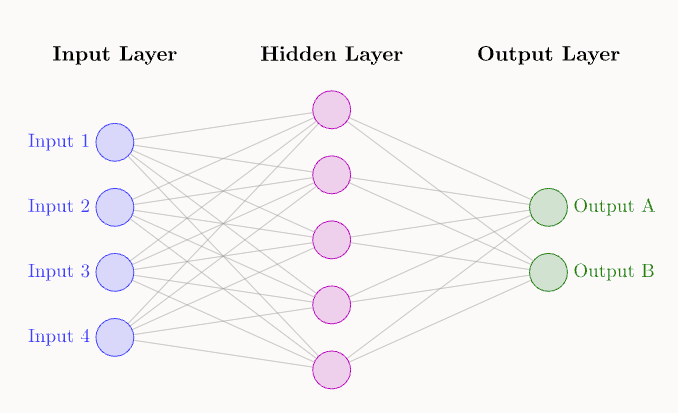
So how does a model like this learn? The process starts with pre-training. The LLM is fed a colossal amount of text data—essentially, a huge chunk of the internet, including books, articles, and websites. Its task is simple but powerful: predict the next word. Given the phrase “The sun rises in the…”, the model learns to predict “east.” By doing this billions of times, it internalizes grammar, facts, reasoning skills, and even biases present in the data.
pre-training is like building a general understanding of the world and language. The next step, fine-tuning, is like specializing in a particular job.
During fine-tuning, the pre-trained model is trained on a smaller, more specific dataset to optimize it for certain tasks, like holding a conversation or summarizing legal documents. This stage often involves a technique called Reinforcement Learning with Human Feedback (RLHF), where human reviewers rate the model’s responses. Good responses are rewarded, and bad ones are discouraged, helping to align the model’s behavior with human preferences and safety guidelines.
What LLMs Can Do
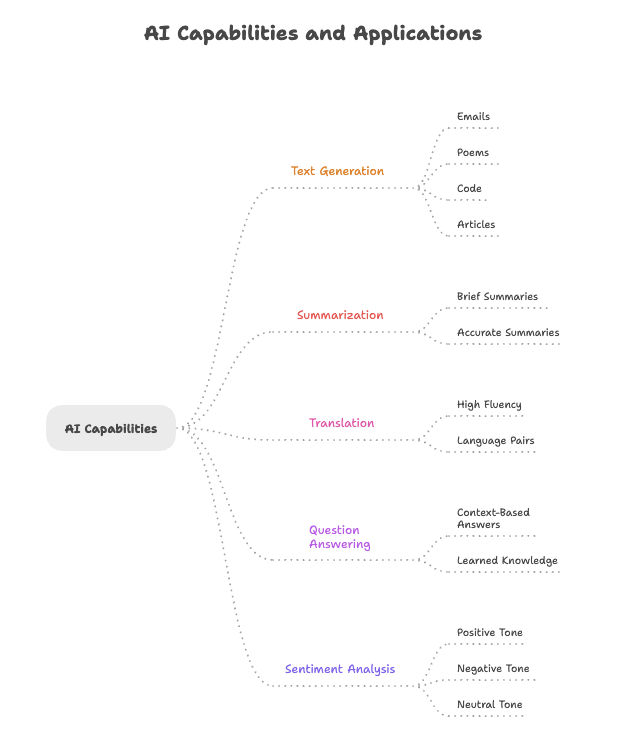
LLMs have revolutionized the field of Natural Language Processing (NLP), which focuses on enabling computers to understand and use human language. Their capabilities are broad and form the basis for many AI tools we use today.

| Capability | Description |
|---|---|
| Text Generation | Creating original text, from emails and poems to code and articles. |
| Summarization | Condensing long documents into brief, accurate summaries. |
| Translation | Translating text between different languages with high fluency. |
| Question Answering | Providing direct answers to questions based on context or learned knowledge. |
| Sentiment Analysis | Identifying the emotional tone (positive, negative, neutral) behind a piece of text. |
For an AI agent, these abilities are crucial. An agent can use an LLM to understand a user’s typed command (perception), figure out the steps needed to fulfill the request (reasoning), and generate a helpful, human-like response (action).
Challenges and Ethics
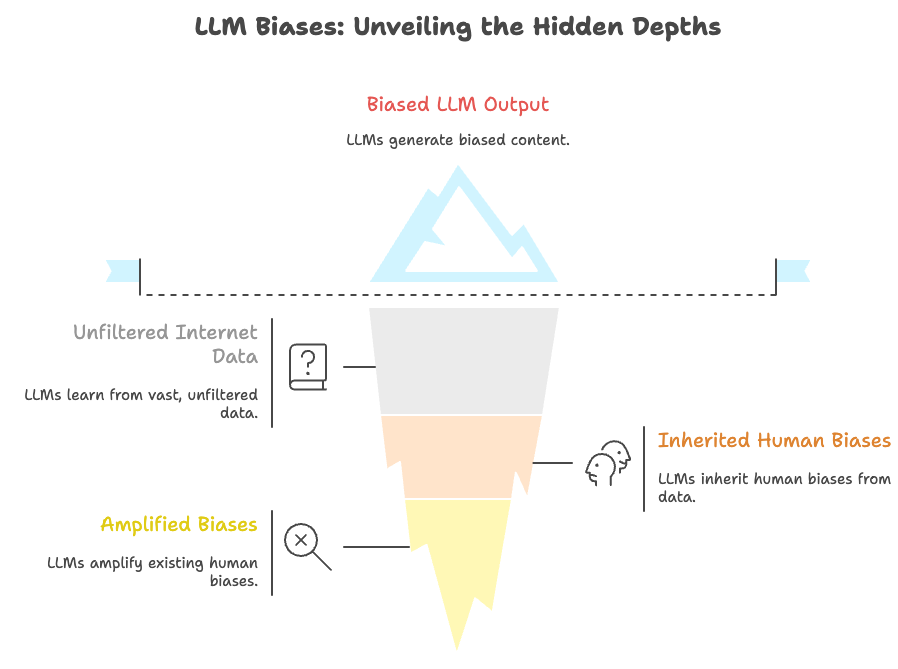
Despite their power, LLMs come with significant challenges. Since they learn from vast, unfiltered swathes of the internet, they can inherit and amplify human biases related to race, gender, and culture. A model trained on biased text might generate biased or stereotypical content.

A phenomenon where an AI model generates false, nonsensical, or factually incorrect information but presents it as if it were true.
Hallucination
Another major issue is the tendency for LLMs to “hallucinate,” or confidently state incorrect information. Because their primary goal is to generate plausible-sounding text, they can sometimes invent facts, sources, or details that are completely false. This makes them unreliable for tasks where factual accuracy is critical, like medical diagnosis or financial advice.
There are also ethical concerns around their use. LLMs can be used to generate convincing misinformation or spam at a massive scale. The data used to train them often includes copyrighted material or personal information scraped from the web without consent, raising serious privacy and legal questions.
Developing LLMs that are fair, accurate, and safe is an ongoing challenge. It requires careful data curation, continuous refinement through techniques like RLHF, and a clear understanding of their limitations.
LLMs provide the powerful language understanding and generation capabilities that are transforming how AI agents reason and interact. By understanding how they work, their applications, and their limitations, we can better appreciate both their potential and the importance of using them responsibly.