This article is going to brief about creating new files , directories, changing the file permission, installing package and managing the services using puppet server on puppet agent nodes. For an example, if you want to configure the ntp client on 100’s of servers , you could simply write a small manifest on puppet server […]
Puppet – Writing a First Manifest – Modules
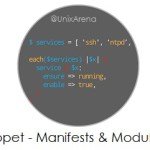
It’s time to write first manifest on the puppet server. This article is going to brief about writing a custom puppet script to automate the installation of httpd/Apache package on Linux servers. Similar way you can automate package installation, updating files, configuring services and many more. Resources are defined using resource declaration syntax and stored […]
Puppet Server – Code and Configuration Directories

This article will brief about the puppet server’s directory architecture and important configuration files. We can classify the puppet server directories as 1. Code Directory and Data Directory 2. Config directory. Puppet’s code directory is a main directory to store the code and data. It contains environments which stores manifests and modules. Manifest directory contains site.pp and nodes.pp […]
Puppet – Resource Declaration – Overview

Resources are essential unit to perform the system configuration. Each resource will describe the particular thing in puppet. For an example, specific user needs to be created or specific file needs to be updated across the puppet agent nodes. When you would like to manage the users, “user” resource type will come in to play. If you want […]
Puppet – What is Facter ? How it works ?

This article is going to brief about Puppet’s Facter. It’s a cross platform system profiling library which helps to provide the similar formatted output on all the operating systems. Puppet agent uses facter to send the node information to the puppet server and this is required when you compile the node’s catalog. Facter system profiling library is part of […]
Puppet – How to install and configure Puppet Agent (Client) ?
Once you have configured the Puppet Server, you can start adding the puppet agents to it. This article will brief about installing and configuring the puppet agent on Linux systems (RHEL 7 and Ubuntu 14.04). Puppet agents are nothing but the client machines which will regularly pulls configuration catalogs from a Puppet master and applies them […]
Puppet – How to install and configure Puppet Enterprise (Master) ?
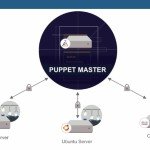
This article is going to brief about the Puppet Server – Enterprise installation and configuration. We are going to install the puppet server in monolithic mode. In monolithic installation, Puppet Master , Puppet console , Puppet DB will be installing on one node. This is the simple method to evaluate puppet enterprise and you can manage up to 500 puppet agent […]
Puppet – Configuration Management Software – Overview
Puppet is an open-source configuration management / IT automation software that allows system administrators to programmatically provision, configure, and manage servers, network devices, and storage, in a datacenter or in the cloud. Puppet is written on RUBY language and it is produced by Puppet Labs. Configuration Management tools uses either push or pull methods. Puppet uses pull method. […]
RHEL7 – Configuring GFS2 on Pacemaker/Corosync Cluster

This article will briefly explains about configuring the GFS2 filesystem between two cluster nodes. As you know that GFS2 is cluster filesystem and it can be mounted on more than one server at a time . Since multiple servers can mount the same filesystem, it uses the DLM (Dynamic Lock Manager) to prevent the data corruption. […]
RHEL 7 – How to configure the Fencing on Pacemaker ?

Fencing (STONITH) is an important mechanism in cluster to avoid the data corruption on shared storage. It also helps to bring the cluster into the known state when there is a split brain occurs between the nodes. Cluster nodes talks to each other over communication channels, which are typically standard network connections, such as Ethernet. Each […]