
KVM hosts needs to be prepared to store and provide the network access to the guest machines. In last article ,we have seen KVM package installation and VMM(virtual Machine Manager) package installation. Once you have installed the packages, you need to create the filesystem to store the virtual machines images (/var/lib/libvirt/images which is the default storage […]
Redhat Enterprise Linux – KVM Installation Part 2

This article will demonstrates that how to install the KVM (kernel-based virtual Machines) packages on Redhat enterprise Linux 7.2 . We must have “yum repository” to install the KVM packages and it’s dependencies. There are many GUI tools available to manage the KVM. VMM (Virtual Machine Manager) is famous GUI tool which was developed by […]
Kernel Based Virtual Machine (KVM) – Overview Part 1
KVM is free open source full virtualization solution for Linux on x86 hardware. After the cloud revolution, KVM(Kernel Based Virtual Machine) Virtualization is a hot topic in the industry. Most of the cloud technologies will prefer to use the KVM hypervisors over XEN due to it’s simplicity. Redhat and Ubuntu’s default hypervisor is KVM. Contrast to these vendors, Oracle Linux […]
How to Patch/Update RHEL 7 without internet connection ?
Linux is not a windows operating system to install the security patches and other bug fix patches for every week. At the same time , it’s not like an Unix operating system where you no need to patch it for years. You should plan to patch the Redhat Linux yearly twice to eliminate the security […]
NetApp – Clustered DATA ONTAP – Tutorial
NetApp Clustered Data ONTAP is one of the emerging technology in the storage market. Cloud technologies demonstrated that how to reduce the IT operation cost by utilizing commodity hardware. This was the wake call for many of the proprietary hardware vendors in the market to provide the cheapest and reliable solution to the customer. So NetApp has […]
NetApp – Clustered DATA ONTAP – SAN – Part 14
NetApp is a unified storage. It supports both NAS and SAN protocols. SAN is a block-based storage system that uses FC, Fibre Channel over Ethernet (FCoE), and iSCSI protocols to make data available over the network. Starting with the Data ONTAP 8.1 operating system, clustered Data ONTAP systems began supporting SANs on clusters of up to […]
NetApp – Clustered DATA ONTAP – Configure Export policy – Part 13
Export polices are used to restrict the NFS/CIFS access to the volumes to clients that match specific parameters. Export polices contains one or more rules that process each client access request . A Vserver can contain multiple export polices and each volume can be associate with desired export polices to provide the access to the clients. By […]
NetApp – Clustered DATA ONTAP – Volumes – Part 12
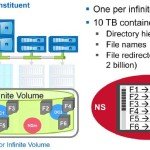
In NetApp , Volumes are used to store the system data, filesystem and clients data. By default, node’s operating system (mroot) is installed on volume “vol0”. Volumes are created on top of aggregates and vol0 resides on aggr0 by default. The “volume create” command creates a volume on a specified Vserver and storage aggregate. NetApp offerers there […]
NetApp – Clustered DATA ONTAP – Data Vserver (SVM)- Part 11
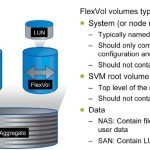
NetApp Clustered data ONTAP consists three type of vServers, which is helping in managing the node, cluster and data access to the clients. Node Vserver – Responsible to Manage the nodes. It automatically creates when the node joins the cluster. Admin Vserver – Responsible to Manage the entire cluster. It automatically creates during the cluster setup. Data Vserver – cluster […]
NetApp – Clustered DATA ONTAP – Storage Failover – SFO – Part 10
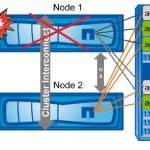
In NetApp Storage system, RAID feature will provide the fault tolerance in-case of any disk failures. But what will happen if the controller(node) itself fails ? NetApp ships the controllers as HA pairs (Two controllers in one chassis ). If one node fails , automatically other controller will take over the storage. Enabling storage failover (SFO) is […]