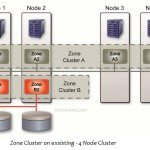
This article explains about zone cluster. Zone cluster is created on oracle Solaris hosts using sun cluster aka Oracle Solaris cluster. In Most of the deployments , we might have seen the failover zones (HA Zones) using sun cluster or Veritas cluster (VCS) on Solaris. Comparatively , zone clusters are very less in the industry […]
VMturbo 5.5 – Manage All Hypervisors in One Umbrella
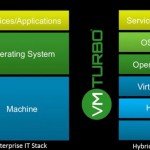
VMturbo operation manager is not just enterprise monitoring software . It controls the virtualization infrastructure by drilling down to the application level and takes real-time decisions. VMturbo controls all the IT stacks like System hardware, Hypervisor, Virtual Machine , Operating System, OS container and applications. VMturbo 5.5 also supports IBM PowerVM along with VMware vSphere , Redhat’s […]
How to break GRUB / Recover Root password on VCSA 6.0 ?

This article will provide the step by step screenshot to recover the VCSA 6.0’s root password and breaking the GRUB password. VMware vCenter Appliance(VCSA) is a pre-configured Linux VM based on SUSE Linux. If you forget the root password of the appliance, you need to recover the root password like other Linux Operating systems. Recovering […]
VMware Integrated Openstack – Overview – Part 1

This articles provides the overview of VMware Integrated Openstack (VIO). Openstack is an opensource framework for creating an IAAS (Infrastructure as a service) cloud. It provides a cloud style API to simplify the consumption of virtual infrastructure technologies. Openstack doesn’t not provide any virtual technologies to create the OS instances. It always require hypervisors like KVM, […]
Puppet – Puppet Forge Modules – Overview
Puppet forge is a module repository for Puppet Open Source and Puppet Enterprise IT automation software. These modules are written by puppet community members and puppet reviews the module before publishing it. Puppet also supports many of modules in this repository. Why do we require pre-built puppet modules ? To simply system administrator work and […]
Puppet – How to Classify the Node types ?
We need to classify the nodes when you have to perform similar operation on different OS variant. For an example, If you want to install Apache package on Linux systems, you need to use package name as “httpd” on Redhat variants and “apache2” on Debian variants. In such a cases, you need to tweak your module […]
Puppet – Augeas – Edit System configuration files
This article is going to demonstrates that editing/updating files on puppet agent nodes. In the previous article , we have seen that how to copy the static files from “module/files” directory(Puppet Server) to puppet agent nodes. But sometimes , you can’t replace the complete file and you may need to edit specific line on that. For example […]
Puppet – Manifest examples – Managing FILES – SERVICES
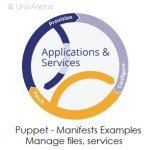
This article is going to brief about creating new files , directories, changing the file permission, installing package and managing the services using puppet server on puppet agent nodes. For an example, if you want to configure the ntp client on 100’s of servers , you could simply write a small manifest on puppet server […]
Puppet – Writing a First Manifest – Modules
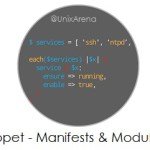
It’s time to write first manifest on the puppet server. This article is going to brief about writing a custom puppet script to automate the installation of httpd/Apache package on Linux servers. Similar way you can automate package installation, updating files, configuring services and many more. Resources are defined using resource declaration syntax and stored […]
Puppet Server – Code and Configuration Directories
This article will brief about the puppet server’s directory architecture and important configuration files. We can classify the puppet server directories as 1. Code Directory and Data Directory 2. Config directory. Puppet’s code directory is a main directory to store the code and data. It contains environments which stores manifests and modules. Manifest directory contains site.pp and nodes.pp […]